


Imin Kao, PhD
 Professor, Mechanical Engineering
Executive Director of SUNY Korea
Office: Light Engineering 167
Email Address: imin.kao@stonybrook.edu
Phone Number: (631) 632-8308
Lab Website: Manufacturing Automation Lab (MAL) Website
Bio:
As the Director of the Manufacturing Automation Laboratory (MAL), Imin Kao conducts research in the areas of robotics and manufacturing automation, engineering-medicine and surgical navigation systems, dexterous manipulation with soft fingers, wafer manufacturing, wiresaw, MEMS, and intelligent fault detection and diagnosis (iFDD). He was the first to conduct research in modeling and control of the wiresaw manufacturing process, and his work has contributed to establishing and developing a fundamental understanding of modern slurry wiresaw slicing technology, which has become the major technology to replace the ID saw in wafer slicing, especially for large-diameter silicon crystal ingots.
In recent years, Dr. Kao has expanded his research into engineering-medicine, developing vision guided surgical systems for intraoperative guidance during bone tumor resections, and pioneering the use of Raman spectroscopy combined with machine learning for real-time tumor tissue detection and margin assessment — work conducted in close collaboration with the Departments of Orthopedics, Pathology, and Radiation Oncology at Stony Brook Medicine. His research has been funded by NSF, ARPA, DoE, SME, GT Equipment Technologies, BCAM International, and numerous other industry partners.
Dr. Kao was an Associate Editor of the IEEE Transaction on Robotics and Automation, and the International Journal of Advanced Manufacturing Systems. He is a member of the editorial board of ROBOMECH. He is a member of the ASME, IEEE, and ASEE. He has authored in excess of 110 refereed papers, several book chapters, and a chapter in the Springer Robotics Handbook.
He is the Founding Faculty Director of the Information and Technology Studies (ITS)
Undergraduate College at Stony Brook University. He is a recipient of the SUNY Chancellor's
Award of Excellence in Teaching and the Student Life Award at Stony Brook University.
He is a member of Tau Beta Pi, the National Honor Society of Engineering, and the
National Academy of Inventors (NAI).
Education:
- Stanford University — Ph.D. in Mechanical Engineering, 1991
- Stanford University — M.S. in Mechanical Engineering, 1986
- National Chung Hsing University, Taiwan — B.S. in Mechanical Engineering, 1981 (Graduated with Honors)
Professional Experience:
- Professor, Department of Mechanical Engineering, Stony Brook University, 1994 - Present
- Executive Director, Academic Degree Programs, SUNY Korea (global campus of Stony Brook University), 2014 - Present
- ABET EAC Commissioner, 2026 - Present
- Executive Director of the Manufacturing and Technology Resource Consortium (MTRC), MEP atSBU, 2017-2022
- Invited to serve on the National Screening Committee of “The Fulbright International Science and Technology Award for Outstanding Foreign Students,” The Institute of International Education (IIE), US Department of State in 2007, 2009, and 2010
Awards & Honors
- Inducted to the National Academy of Inventors (NAI), May 2018
- Inducted to the Phi Tau Phi Scholastic Honor Society of America, November 2016
- SUNY Chancellor's Award for Excellence in Teaching, 2011
- Student Life Award, for outstanding service and contribution to student life, October 2005
- Tau Beta Pi National Honor Society of Engineering — inducted as Professor of Mechanical Engineering, NY Omicron Chapter, April 26, 2002
- Awards of Excellence in Teaching, Pi Tau Sigma Mechanical Engineering Honor Society, May 1996
Professional Memberships & Service:
- Member, National Academy of Inventors (NAI)
- Editorial board of ROBOMECH
- Associate Editor, IEEE Transactions on Robotics and Automation
- Associate Editor, International Journal of Advanced Manufacturing Systems
- Member of ASME, IEEE, and ASEE
- Member, Tau Beta Pi — National Honor Society of Engineering
- Founding Faculty Director, Information and Technology Studies (ITS) Undergraduate College, Stony Brook University
- Proposal reviewer, National Science Foundation (NSF) — various panels
Overview:
Dr. Kao's research spans robotics, manufacturing automation, and engineering-medicine,
with recent emphasis on developing innovative tools for surgical guidance and real-time
cancer diagnosis. His lab has pioneered the use of Raman spectroscopy combined with deep learning for tumor tissue detection and margin assessment, as
well as vision-guided systems for intuitive orthopedic surgery. In robotics, he advances fundamental impedance
control theory for redundant manipulators. His research work in wiresaw manufacturing
helped the understanding of the foundation of technology for slicing large diameter
silicon crystal ingots. Ongoing projects include clinical studies in collaboration
with Stony Brook Medicine's Departments of Orthopedics, Pathology, and Radiation Oncology,
and new control frameworks for robotic-assisted surgical applications by employing
the enhanced impedance control.
Highlights & Accomplishments:
- Developed Vision-Guided System for Intuitive Orthopedic Surgery — projects osteotomy lines directly onto bone during tumor resection, eliminating reliance on external navigation monitors.
- Used Raman Spectroscopy and Machine Learning for the Detection of Tumor Tissues — ex-vivo study on 286,672 spectra across 7 patients achieved 97.1% weighted accuracy and a 1.46% clinical alert rate using a custom ResNet architecture.
- Vision-Guided Surgical System for Pelvic Tumor Resections — reduced mean distance deviation from 2.07 mm (freehand) to 1.01 mm; roll angle deviation from 15.36° to 4.21°; pitch deviation from 6.17° to 1.84° (all p < 0.05).
- New Enhanced Impedance Control for Redundant Robots — regulates Zero-Potential-Energy (ZP) motion due to kinematic redundancy, enabling natural physical motion aligned with the minimum energy principle.
- Pioneer in Wiresaw Manufacturing — first to model and control the wiresaw manufacturing process; foundational research now underpins the dominant technology for large-diameter silicon wafer slicing.
Research Areas:
Research Interests:
- Clinical trials and implementation in the operating room (OR) of Raman spectroscopy-based tissue classification systems
- Optics and signal processing — reducing saturation in Raman handheld probes for improved clinical accuracy
- Applications of new impedance and stiffness control frameworks in robotic and surgical systems
- Engineering-medicine integration: orthopedic surgery, cancer diagnosis, bone repair, and rehabilitation
- Wafer manufacturing, wiresaw technology, MEMS, and intelligent fault detection and diagnosis (FDD)
Selected Publications:
- M. Boroji, V. Danesh, D. Barrera, E. Lee, P. G. Arauz, R. F. Farrell, B. F. Boyce,
F. A. Khan, and I.
Kao. "Ex-vivo Raman spectroscopy and AI-based classification of soft tissue sarcomas." PLoS One
20(9): e0330618. September 2025. https://doi.org/10.1371/journal.pone.0330618 - V. M. Mustahsan, L. Li, M. Boroji, Y. Cai, G. He, F. B. Tavernier, J. Oentoro, E.
Lee, F. Khan, B. F.
Boyce, and I. Kao. "Application of Raman Spectroscopy Using a Handheld Probe to Characterize Human White Adipose Tissue." Journal of Raman Spectroscopy, vol. 56, Issue 8, pp. 722-732. August 2025. https://doi.org/10.1002/jrs.6806 - V. Danesh, P. Arauz, M. Boroji, A. Zhu, M. Cottone, E. Gould, F. A. Khan, and I. Kao.
"Improved Accuracy in Pelvic Tumor Resections Using a Real-Time Vision-Guided Surgical
System." Journal of Orthopaedic Research, vol. 43, no. 8, pp. 1485-1492. August 2025. PMID:
40407191. https://doi.org/10.1002/jor.26111
Books
- "Wafer Manufacturing: Shaping of Single Crystal Silicon Wafers."Wiley Publisher, January
2021.
ISBN: 978-1-118-69623-1. (304 pages) - "Vibration Analysis and Control of Mechanical Systems." Springer Nature. (Under contract, 2022)
Images:
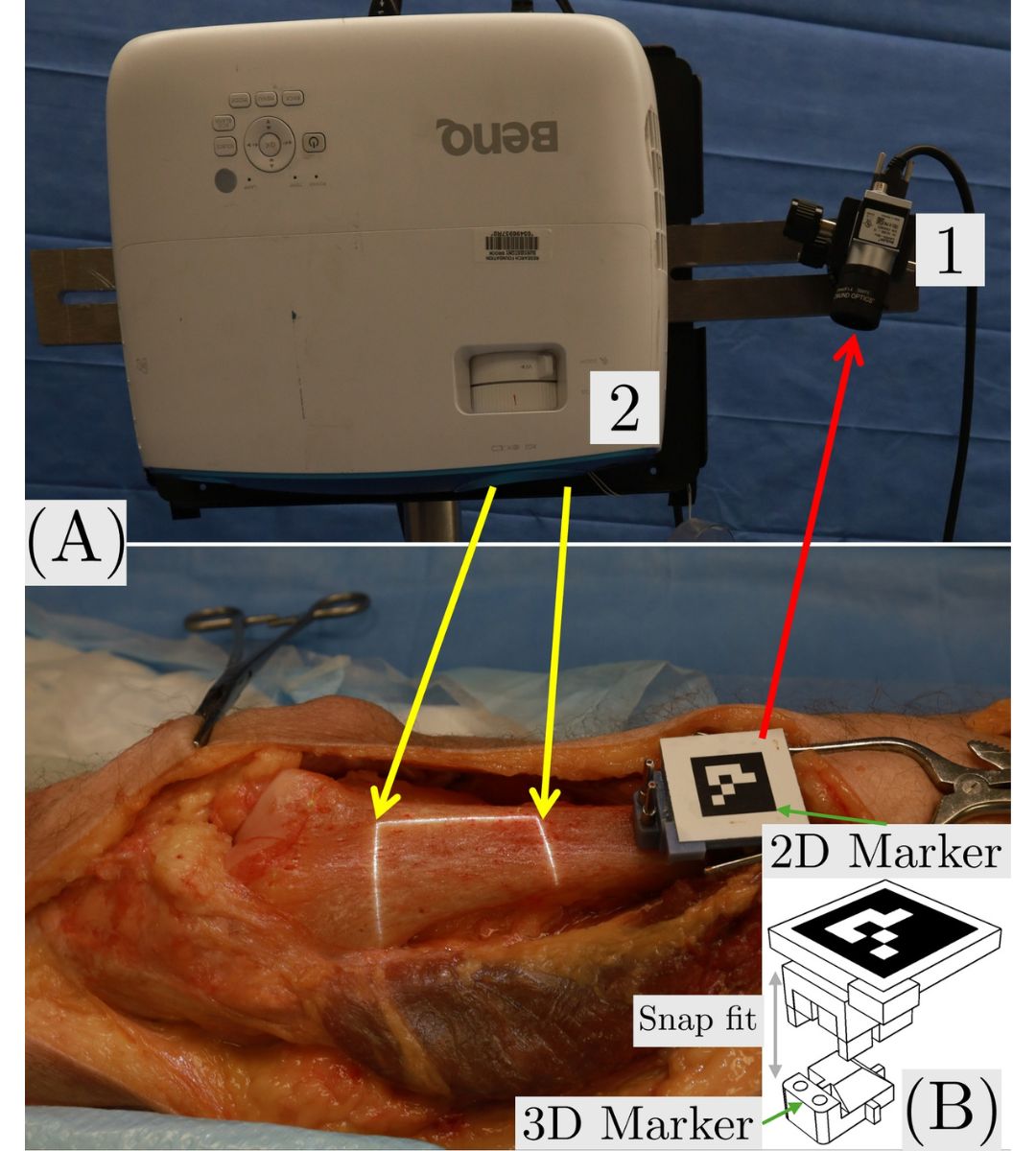
The vision-guided surgical system: In (A), Label 1 indicates a HD camera, and Label
2 indicates a projector. The pre-operative U-shaped osteotomy lines are projected
onto the bone surface for guiding the resection of osteosarcoma. In (B): ”A zoom-in
view of the 2D marker next to the osteotomy lines for real-time tracking, which is
snapped onto a 3D marker on the bone surface.
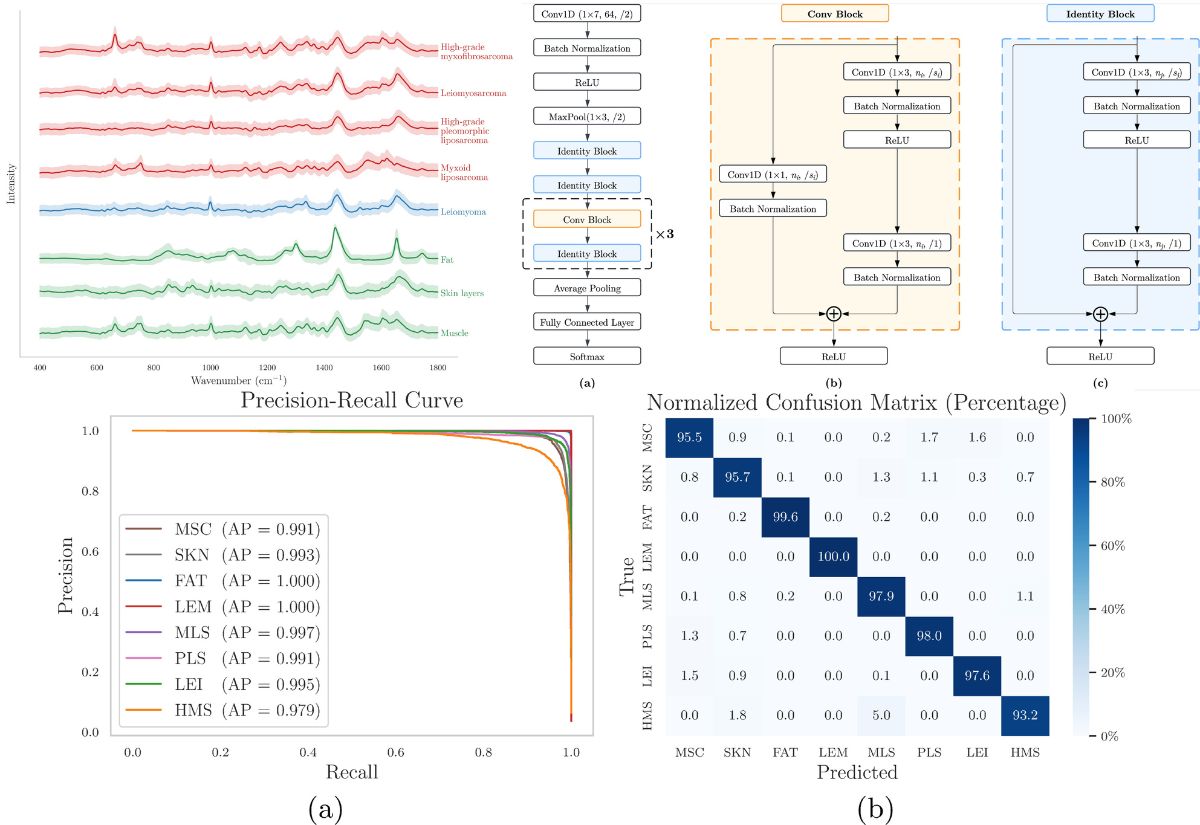
Raman measurements were shown in the upper-left graph. A custom ResNet machine learning architecture was developed to classify different tissue types, achieving an overall weighted accuracy of 97.1% and a clinical alert rate of 1.46%.