


Thomas Hemmick
Distinguished Teaching Professor
Physics and Astronomy
Office: Physics C 107
Research Group Website | Curriculum Vitae. (Last updated: 2024 Feb 22)
Biography:
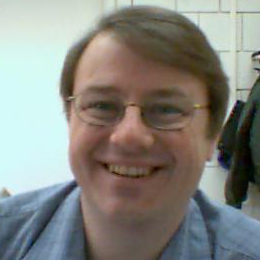
Thomas Hemmick holds the title Distinguished Teaching Professor at Stony Brook University.
He got his Ph.D. from the University of Rochester, in 1989, working with the Tandem
Accelerator Mass Spectrometry Group on multi-disciplinary work touching geology, hydrology,
anthropology, peripheral participation in the dating of the Shroud of Turin, and searches
for anomalous isotopes of low Z nuclei which would be a natural consequence of any
strongly or electromagnetically interacting, stable, and undiscovered particle (technicolor,
H-dibaryon, lightest SUSY particle, …). He switched to studies to Relativistic Heavy
Ion Collisions at both the AGS and RHIC at the formative stage of those programs.
He was named Fellow of the American Physical Society in 2021, with a citation for
his development of detectors for nuclear physics, mentoring of students, and advancements
in the field of Relativistic Heavy Ion Collisions. He co-chaired the Particle-ID working
group that developed the concepts for particle ID at the future electron-ion collider
(EIC). He holds numerous teaching awards and has developed both the online lecture
and lab classes for introductory physics.
Research Statement:
Most of my career, my research has focused on the studies of the quark-gluon plasma.
I am a founding member of the PHENIX experiment at RHIC, wherein I led the construction
of the focal plane (5120 PMTs) of the PHENIX RICH, the PHENIX Drift Chambers (principle
tracking detectors), the PHENIX Hadron Blind Detector (the first CsI-based GEM detector
and record holder for the brightest Cherenkov detector ever built with N0=325cm-1), the PHENIX MPC-EX (among the earliest preshower detectors with pixelated silicon
sampling), and most recently the Time Projection Chamber (TPC) for the sPHENIX experiment.
sPHENIX had an engineering run in 2023 and physics runs in 2024, 2025/2026. This
short time span nonetheless created the highest statistics recorded in the history
of RHIC for pp, OO, and AuAu collisions at the RHIC top energy.
My interests have varied over the years from thermodynamics and hadrochemistry of the QGP (highlighted by a measurement of the Delta resonance at the AGS), to penetrating probes through the e+/e- channel to access the initial temperature of the QGP. In sPHENIX, my interests have moved to a measurement of the Debye screen radius of the plasma, accessible through measurements of the three Upsilon states (made possible for the first time by the high precision Time Projection Chamber) and probing the onset of deconfinement using the never-before studied OO collisions. All these studies have a common theme: the emergent properties of strongly interacting bulk matter. Emergent properties of the electromagnetic interaction face us every day in processes as simple as the hydrodynamics of pouring water into a glass to the optics of the lens formed by the filled glass. Similarly the Quark-Gluon Plasma reveals the equally beautiful emergent properties of the strong interaction.