


Professor Shikui Chen Receives DOE Genesis Mission Award
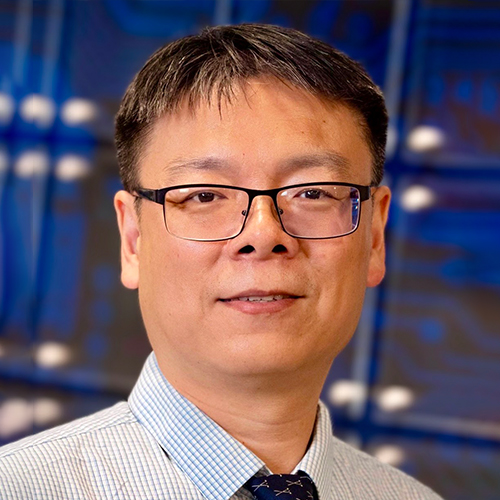 Professor Shikui Chen of the Department of Mechanical Engineering has received an
award through the U.S. Department of Energy's (DOE) Genesis Mission, a national initiative
that leverages artificial intelligence to accelerate scientific discovery and advance
innovations in energy, engineering, and national security.
Professor Shikui Chen of the Department of Mechanical Engineering has received an
award through the U.S. Department of Energy's (DOE) Genesis Mission, a national initiative
that leverages artificial intelligence to accelerate scientific discovery and advance
innovations in energy, engineering, and national security.
Chen's project, "Geometry-Informed AI for Accelerated Multiphysics Co-Design of Wide-Bandgap Power Modules," will develop a geometry-informed AI framework to accelerate the multiphysics co-design of wide-bandgap power modules. Focusing on a representative silicon-carbide half-bridge package, the team will combine AI-based geometry representation, multiphysics simulation, and design optimization to rapidly predict thermal and thermo-mechanical performance and identify improved package designs. The resulting designs will also be evaluated through experimental thermal testing.
By integrating artificial intelligence with advanced engineering simulations, the project aims to transform the way power electronics are designed. The AI framework will help researchers understand how a device’s physical structure and materials influence factors such as heat management, mechanical reliability, and overall performance. This approach will allow engineers to explore and optimize new designs more efficiently, reducing development time while creating power modules that are more reliable, durable, and better suited for next-generation technologies such as electric vehicles, renewable energy systems, and advanced energy infrastructure.
The Stony Brook research team includes Professor Shikui Chen (Mechanical Engineering), Professor Fang Luo (Electrical and Computer Engineering), Professor Xianfeng David Gu (Computer Science), and Professor Nengkun Yu (Computer Science). The project also includes collaborators from GE Vernova Advanced Research and Sandia National Laboratories.
"We are honored to receive support through the U.S. Department of Energy's Genesis Mission," said Chen. "This project brings together expertise in geometry-informed artificial intelligence, multiphysics modeling, power electronics, and design optimization to accelerate the development of next-generation wide-bandgap power modules. We hope the resulting workflow will significantly reduce design-cycle time while improving the thermal performance, reliability, and manufacturability of advanced power-electronics systems."
Announced at the Genesis Mission Summit in Washington, D.C., the DOE's Genesis Mission brings together national laboratories, universities, industry, and government partners to harness AI for breakthroughs in energy, scientific discovery, and national security.
Chen's project was one of six inaugural Genesis Mission awards received by Stony Brook University. Together, the awards bring more than $1.6 million in funding to the university and reflect Stony Brook's growing leadership in artificial intelligence, advanced computing, engineering, and interdisciplinary research. The university was among just 278 awardees selected from more than 5,000 applications submitted nationwide.
For More Information:
- Stony Brook University Researchers Chosen for Landmark DOE Genesis Mission AI-for-Science Awards (SBU News)
-
Stony Brook University secures $1.6M for AI, science research (Long Island Business)