


Graduate Research Poster Symposium Showcases Innovation Across Emerging Technologies
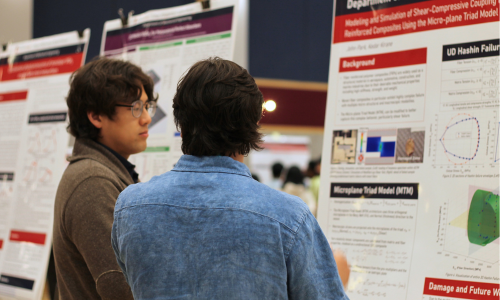 On April 17, graduate students from the Stony Brook University Department of Mechanical
Engineering gathered for the 2026 Graduate Research Poster Symposium, highlighting
the wide range of research underway across the department. More than 40 PhD and master’s students presented their work, sharing discoveries and
innovations spanning robotics, advanced materials, artificial intelligence, thermo-fluid
dynamics, manufacturing, and design.
On April 17, graduate students from the Stony Brook University Department of Mechanical
Engineering gathered for the 2026 Graduate Research Poster Symposium, highlighting
the wide range of research underway across the department. More than 40 PhD and master’s students presented their work, sharing discoveries and
innovations spanning robotics, advanced materials, artificial intelligence, thermo-fluid
dynamics, manufacturing, and design.
In addition to creating research posters, each participant took part in an "Elevator Pitch" competition, presenting a single PowerPoint slide and a one-minute overview of their project to faculty members and fellow students. The fast-paced presentations challenged students to communicate complex engineering concepts clearly while showcasing the breadth of research taking place across the department. At the conclusion of the event, awards were presented to the top posters in the areas of Thermo-Fluids, Solid Mechanics, and Manufacturing & Design.
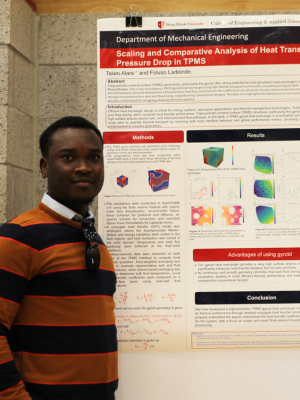 Amanda Flanagan, Department Manager and co-organizer of the event, emphasized the
value of bringing researchers together across disciplines.
Amanda Flanagan, Department Manager and co-organizer of the event, emphasized the
value of bringing researchers together across disciplines.
"Our annual Graduate Poster Symposium highlights the exceptional breadth of research taking place within our graduate program while creating valuable opportunities for collaboration and connection across disciplines."
The presentations reflected the diverse challenges being tackled by Mechanical Engineering researchers.
Several projects focused on advancing robotics by making machines more capable, adaptable, and responsive. Research in this area included robots that can learn new tasks from a single human demonstration, underwater robots inspired by sea turtles, mathematical models that help robotic systems determine the best way to grasp and manipulate objects, and soft, flexible sensors that give robots a sense of touch similar to human skin.
Artificial intelligence also emerged as a common thread throughout the symposium. Graduate researchers applied machine learning to accelerate engineering design, improve computer simulations, automate manufacturing processes, and better understand how mechanical systems move and interact with their environments.
Research in thermo-fluid dynamics explored the movement of heat, fluids, and energy across a variety of applications. Projects examined cloud formation through high-resolution computer simulations, developed new methods for visualizing fluid behavior using lasers and imaging systems, and investigated advanced heat exchanger designs that could improve the efficiency of cooling and energy systems.
Graduate students also presented research on advanced materials and manufacturing, from improving flexible solar panel fabrication to developing stronger composite materials and more accurate models for predicting how engineering materials deform and fail. Together, these projects aim to help engineers design lighter, more efficient, and more reliable technologies.
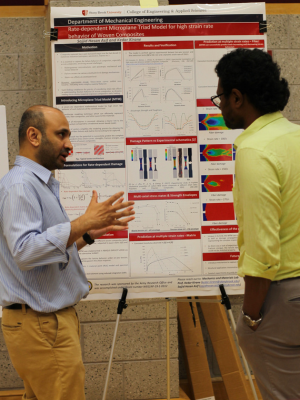 The annual symposium not only highlighted the depth and diversity of graduate research
in Mechanical Engineering but also provided students with an opportunity to strengthen
their communication skills, exchange ideas with peers and faculty, and build new interdisciplinary
collaborations. The event serves as a celebration of the innovation and creativity
driving the department's graduate research community.
The annual symposium not only highlighted the depth and diversity of graduate research
in Mechanical Engineering but also provided students with an opportunity to strengthen
their communication skills, exchange ideas with peers and faculty, and build new interdisciplinary
collaborations. The event serves as a celebration of the innovation and creativity
driving the department's graduate research community.
Assistant Professor William Stewart, co-organizer of the event, said the symposium continues to inspire new ideas long after the presentations have ended.
"The annual poster symposium is a great time to spread novel ideas and find collaborations across research fields. I always feel like I have more creative thoughts after attending."