Sara S. Barenfeld
Ph.D. Student
Department of English
Inside the Magical Mind of Fernando Pessoa: An Exploration of Early Portuguese Modernism and One Writer’s Wondrous Search for Belonging
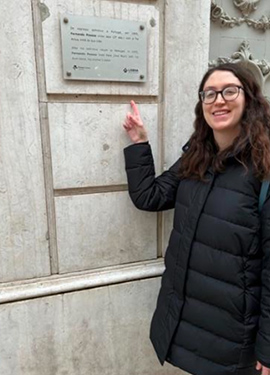
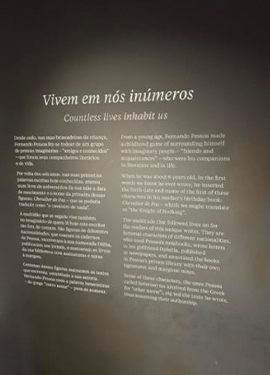
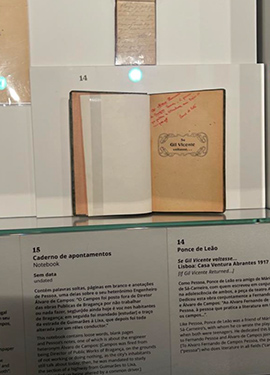
In early January 2026 over my winter break, I had the distinct privilege of traveling to Lisbon, Portugal to research the acclaimed Portuguese poet and writer: Fernando Pessoa (b. 1888- d. 1935) on the ground in his birthplace. Here is what I knew before from some of my prior readings and research before I arrived: Pessoa was perhaps quite literally an “odd bird.” He was fascinated with the occult and all things magical. He published under a record number of heteronyms; totaling at least 75 other names and identities. Pessoa created entire personas and fictitious worlds in which his other identities would converse. However, in Lisbon upon further research I learned Pessoa not only created other identities, but he would immerse himself in these other heteronyms’ astrological charts, clothing styles, rate of speech and idiosyncrasies such as mannerisms. Every detail about these other “people” was accounted so much so Pessoa was able to transform himself and his “mind” into these other names. The astrological chart detail was one of the most fascinating anecdotes because it gave me a window into Pessoa’s own mind and being, which was the purpose of the trip. I aim to publish an article on my research, and I will argue in part that Pessoa lived with what we now know as possibly schizoaffective bipolar disorder. To say he had a “beautiful mind” would be an understatement. For lovers of poetry and the humanities, to honor Pessoa’s writing career in this way such an honor and surreal at points. I felt as if I was viewing Lisbon through Pessoa’s eyes as I turned the cobblestone corners murmuring Pessoa’s sonnets in my mind. As planned, I visited the historic home and museum: Casa Fernando Pessoa, where Pessoa spent the last 15 years of his life. I also visited: the Archive of Contemporary Portuguese Culture (ACPC) at the National Library of Portugal (Lisbon), and I viewed the personal papers of Pessoa. This was where I felt the most intellectually stimulated but albeit was the least scenic compared to the museums.
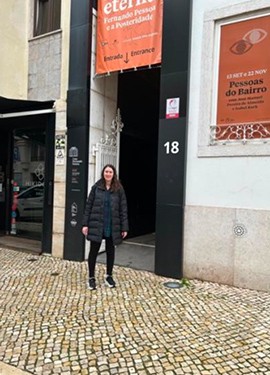
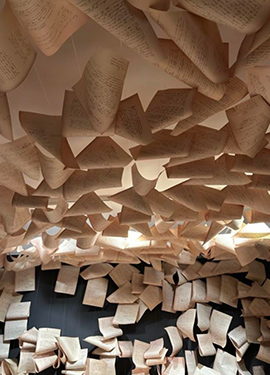
While in Lisbon, I visited “Casa Pessoa,” which is now a museum and where Pessoa lived for some of his life. I realized his mind was much more complex, magical, disturbed, and wonderous than I even imagined. I learned that in a manic state Pessoa wrote a record number of sonnets in one night, which was recreated with the papers on the wall of one room. Nowadays one thinks of mindfulness and trying to calm the mind to reduce stress. However, Pessoa had a mind that could never be quieted. On the right is a recreation of the night Pessoa wrote his record number of sonnets. I am so incredibly grateful for this opportunity and being able to step inside the mind of Pessoa in his native country. I would never Barenfeld 2 have been able to get such a unique feel for Pessoa’s experiences if I had not been afforded the opportunity to travel to Lisbon. I know now whenever I present on this trip that I can speak from personal experience and share with the audience what it felt like to essentially go back in time for a bit and see Lisbon through Pessoa’s eyes. The experience was affective, moving, and ultimately deeply poetic.