Maria Paula Lizarazo
PhD student in Hispanic Language and Literature
Preserving indigenous knowledge to reforest the forest: the case of the Biblioteca del Bosque in Tarapoto Lakes (Amazon)
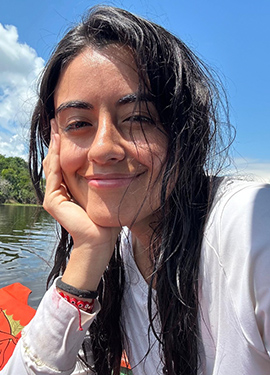
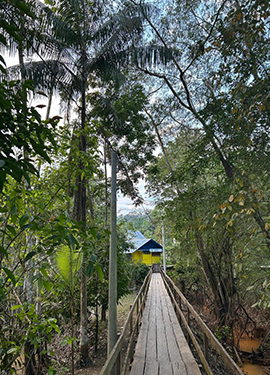
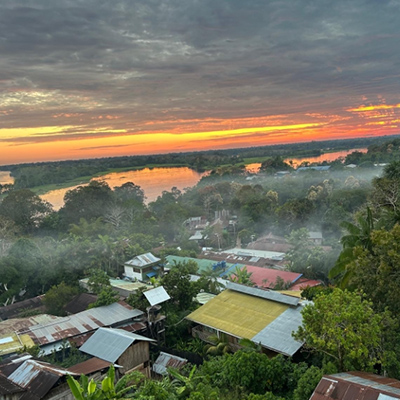
Thanks to the Guiliano Global Fellowship, I have significantly advanced in my research ambitions. I traveled to the Amazon rainforest to visit a mobile library initiative led by Tukano (or Magüta) indigenous communities and the Omacha Foundation, in Puerto Nariño and Tarapoto Lakes, at the frontier between Colombia and Peru.
The ongoing mobile library, called “Biblioteca del Bosque” (Forest Library), contains various volumes to recover indigenous knowledge and memories to share through different local uses such as storybooks for teaching myths in schools; medical guides for use at home; scientific catalogues of important plants; and others.
The variety of volumes in the Library allows me to think critically about print circulation and reception in this region: where oral traditions predominate and where diverse contexts converge, including border dynamics, extractivism, and the loss of indigenous languages; in addition, the Biblioteca del Bosque is related to another project led by these communities, especially women and youth, to reforest floodplain areas: while they are recovering memory, they recover the rainforest.
“Raíces sumergidas” (Submerged roots) is the main volume I'm interested in. It was written by four young people who interviewed elderly people and transcribed 21 stories (or myths) that they told for the book. This helps me to delve deeper into the Amazonian ethos, where indigenous memories are connected to the territory, the territory is imbued with memory, and both mutually revitalize one another.
Both Biblioteca del Bosque and the volume “Raíces sumergidas” propose questions around collectivity and authorship in terms of how categories like testimony and memory, in the Latin American critical tradition, are intervened by or dialogue with these contemporanean and collective narratives in which the place of enunciation of the forest and the spirits are included.
Additionally, this trip to the Amazon allows me to initiate my process to learn the indigenous language Tukano, guided by Albalucia, one of the most significant grandmothers to the communities in Puerto Nariño. Continuing this process will be deeply meaningful for my career.
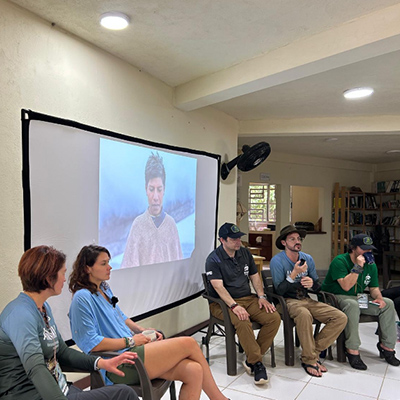
Last but not least, during the trip I attended the course Amazon: conservation and storytelling for its future, taught by international documentalists, including the Oscar-winning Pippa Ehrlich, and organized by the Foundation for International Aid to Animals and Omacha Foundation; this experience was important for continuing to reflect on my approaches to the Western media and platforms, and its representations of the ongoing climate change, particularly in complex regions such as the Amazon.