


Lauren Fulton
Department of Art PhD Candidate
Guiliano Fellow, Fall 2021
“Peripheral Perspectives: Dick Higgins and Embodied Autobiography, c. 1958-79"
(Evanston, IL)
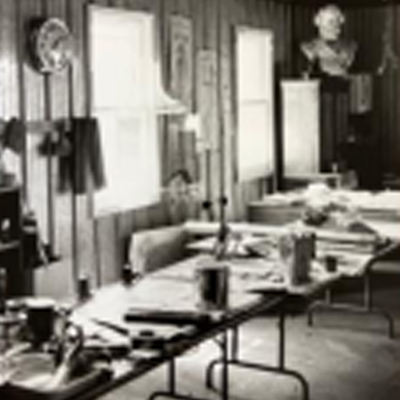
Thanks to the support of the Edward Guiliano Global Fellowship program, I spent one week in Evanston, Illinois at Northwestern University where I conducted dissertation research at the archive of artist, composer, poet, and theorist Dick Higgins (b. 1938–98). At the Charles Deering McCormick Library of Special Collections, I was able to go through images, correspondence, unpublished essays, publicity, and original works of art. Additionally, I examined materials documenting Higgins’ activities that reside in the archives of Charlotte Moorman and John Cage, a collaborator and mentor of Higgins’, respectively.
Most importantly, I was able to access Higgins’ unpublished autobiography written in 1982. The artist’s retrospective look at his life from childhood to the early eighties is a crucial and clarifying resource for my project. As I argue, the specific works and performances that ground each of the four chapters of the dissertation necessitate getting into the specifics of their situational make-up, which ultimately reveals greater texture and nuance. The cliché associated with Fluxus (the movement Higgins co-founded in the early 1960s)—the lack of boundaries and total fluidity between art and life—is regularly acknowledged by scholars, but contextual details surrounding Fluxus artists’ lives are then often cast aside. This is especially true for Higgins whose theory and essays are frequently reprinted and made points of focus, but whose more personal performances, plays, poems, and films are rarely ever looked at through an interpretative lens or with any critical assessment. It is these details (many of which I was able to clarify from my time at the archive), some seemingly tangential or peripheral, that are crucial to understanding Higgins’ most significant bodies of work and foster the long overdue in-depth examination they deserve.
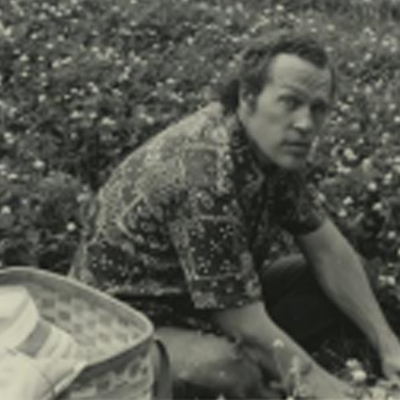
While non-normative sexualities and gender identity was not unusual within Fluxus, scholarship almost entirely lacks mention of it. Gay since childhood, Higgins’ evolving sexuality and exploration of identity spurred work about rebirth and new beginnings, and he can be credited with contributing to early queer art history. As I demonstrate in the dissertation, biography’s queerness can shine light on the many nuances and even contradictions that played out throughout Higgins’ career, an artist whose practice was quickly overshadowed by his identity as publisher of the Something Else Press, an alternative avenue started in 1964 for himself and others associated with Fluxus to circulate their work. While Higgins’ practice cannot be entirely separated from Fluxus, I argue for his work’s importance beyond that label. One guiding question for this project is: How might we, instead, consider Higgins’ output alongside Fluxus, rather than from within it?
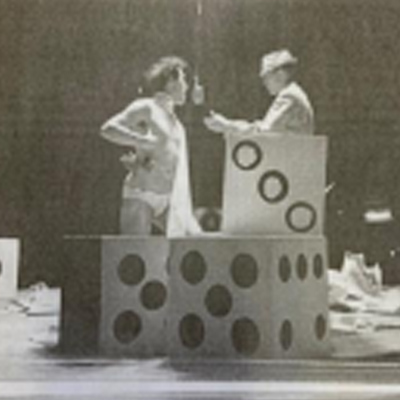
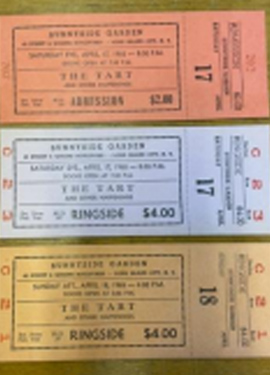
The chapter that I am currently writing is the one that benefitted most from my research at NWU. In it I examine a selection of Higgins’ Danger Music works (1961–63), event scores meant to intentionally put the performer at psychological or physical risk. This series was conceived at the same time as The Tart, or Miss America (1962), which was later performed as “event theater” at the Sunnyside Garden Ballroom and Arena in Queens in 1965. Higgins chose to stage The Tart in a fighting ring, a space he described as one in which catharsis rules through combat, where one “enacts a ritual act of (implied) violence.” The archive provided substantial information on the conceptual complexity and evolution of Danger Music and The Tart, along with fantastic documentation for both.
My visit to Northwestern was also illuminating for how much material I obtained about Higgins’ later years in Barton, Vermont, the period that concludes the dissertation. In this rural setting he created his most prolific series, 7.7.73, an arcadian response to the then-fading Pop art movement. This enormous body of work offers a look at the free-loving, joyful, celebration of nature that characterized Higgins’ (for a time) idyllic life in Vermont. That his most serious nervous breakdown followed, demonstrates the cyclical notion that creation fosters destruction, and vice versa, a generative concept that occupied him for decades.