


Stony Brook University's Chart of Accounts
Stony Brook University implemented a new Chart of Accounts (CoA) as part of the Oracle
Cloud transformation. The CoA is the basic structure used to categorize financial
transactions to provide meaningful reporting in Oracle Cloud. Additional information
on the CoA can be found on the Office of the Controller's website.
What is the Chart?
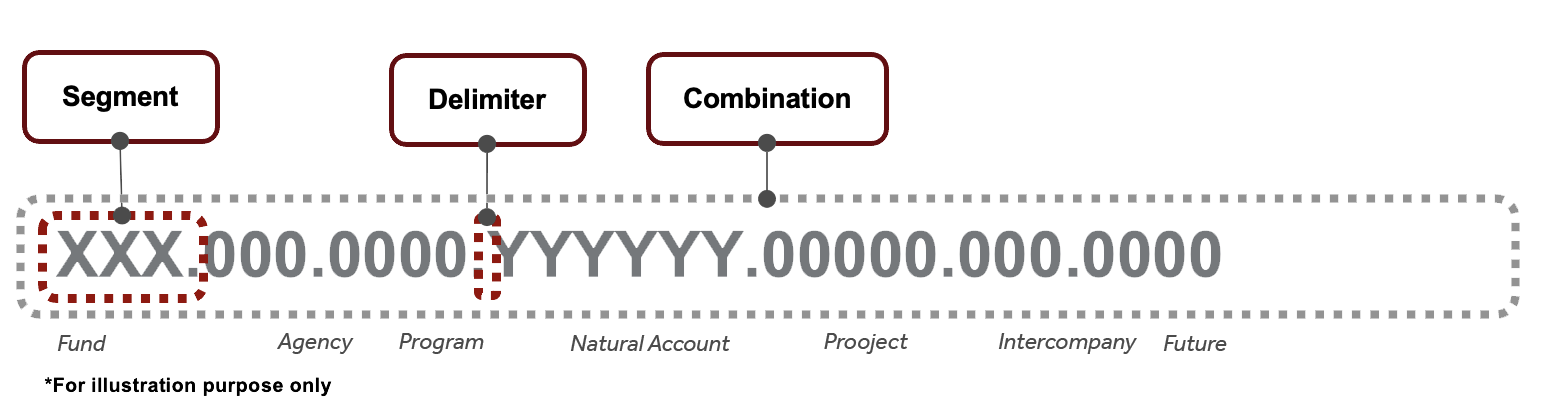
The Chart of Accounts is a set of pre-defined segments (in a pre-defined sequence), with a fixed list of values available under each segment. Every segment is a critical dimension in representing some aspect of the business – legal, financial, operational, management – on the books for every transaction. Every event on a transaction that has a financial impact generates accounting entries posting it to a combination of segment values in the General Ledger. All segments may not be relevant for all transactions, but all segments of a combination entry are always mandatory and cannot be blank.
Terms to Remember
- Segment: Can refer to any single segment of the combination
- Alias or Distribution set: Refers to a unique combination of all segments
- Delimiter: Typically "."(dot) or "-"(dash)
Benefits
The Chart of Accounts can be a powerful tool in representing financial terms for a number of stakeholders. It provides:
- Statutory reporting: Easy and accurate external reporting.
- Internal reporting: Internal and operational reporting requirements.
- Industry standards: Established measurables will help keep SBU in line with peers and competitors.
- Compliance: Fulfill requirements mandated by local regulations.
- Technological capabilities: WolfieONE and related systems are set to capture data effectively.
- Differentiators: Key differentiators can be established to help SBU identify trends and remain successful.
Our remodeled CoA will allow Stony Brook to better capture and categorize operational, managerial and external financial activities in a way that satisfies both our reporting needs and SUNY's required financial reporting. Other benefits include:
-
Improve the overall reporting environment.
-
Provide a framework for monthly financial reports.
-
Provide full GAAP financial statements.
-
Provide a shared chart of accounts structure so campus users can continue to see all fund reporting.
-
Meet internal and external reporting and policy requirements administered by the State, Research Foundation, Stony Brook Foundation and Auxiliary Services Association.
-
-
Create seamless data integration and synchronization between systems, particularly for comparing budget to actuals.
-
Enhance visibility into financial data which improves audit preparedness and reduces the risk of overspending.
-
Provide upload capabilities to SUNY.
Governance Model
- CoA Values and Hierarchies: Develop child and parent values for each CoA segment. Build account hierarchies that enable fast and robust account inquiry and drill.
- Reporting: Analyze financial performance and prepare financial reports using CoA account data.
- Mapping Rules: Define, design, and build the mapping rules for the boundary applications.
- Boundary Applications: Define, design, and build the mapping rules for the boundary applications.
- Data Conversions: Develop flexible mapping between legacy and new CoA. Determine data conversion approach to convert sub-ledger transactions and GL balances using new CoA structure and values.
- Allocations: Identify various rate-based, usage-base, and step-down allocations and validate CoA structure to support them.
- Cross-Validation Rules: Prevent invalid values to be combined with other values across different segments in CoA.
- Security Rules: Control access to parent and detail values in GL and subledgers.