


Hazard Communication Right to Know Program
| EH&S Program | Scope | Responsibility |
|---|---|---|
| Occupational Safety | University Wide | Environmental Health & Safety |
Policy:
Provide a safe workplace where the hazards associated with all chemicals and commercial products used by employees are evaluated, reviewed and communicated to the affected employees.
Procedures:
-
General:
-
The Hazard Communication/Right-to-Know Program includes provisions for container labeling, safety data sheet gathering and employee training. It includes a listing of hazardous chemicals in each work area and procedures for informing employees of the hazards associated with chemicals. The program also includes the facility's obligation to inform contractors of University-owned hazardous chemicals to which their employees may be exposed while performing work at Stony Brook.
-
B. Responsibilities
- Environmental Health and Safety (EH&S) coordinates the Hazardous Communication / Right to Know Program.
- EH&S conducts Hazardous Communication / Right to Know Training initially and on an annual basis and/or as needed.
- Departments and Department Heads keep and maintain updated employee training logs and chemical inventories for their department,
- Contractors work with EH&S and Designated Department Heads, as needed, to ensure hazardous materials are identified before work begins.
C. List of Hazardous Chemicals
- A master list is maintained by the EH&S department located at: 110 Suffolk Hall, Stony Brook, NY 11794 / South Campus.
- Departments and Department Heads maintain lists of all hazardous chemicals used in their facilities and update the lists as new chemicals come into the facility. They forward new or revised product information to EH&S as required.
- Chemical manufacturers and importers are required to evaluate the hazards of the chemicals which they manufacture and provide SDSs for all of their products upon request.
D. Safety Data Sheets (SDS)
- SDSs are readily available to all employees, written in English, and include the following
information:
- Identification of the substance or mixture and of the supplier
- Hazards Identification
- Composition/information on ingredients
- First Aid measures
- Firefighting measures
- Accidental release measures
- Handling and Storage
- Exposure Controls / Personal Protection
- Physical and Chemical Properties
- Stability and Reactivity
- Toxicological Information
- Ecological Information
- Disposal Considerations
- Transportation information
- Regulatory information
- Other information including information on preparation and revision of the SDS
- EH&S maintains an online electronic SDS library (SDSPro) at https://ehs.stonybrook.edu/resources/safety-data-sheet on every substance on the list of hazardous chemicals located on the master list.
- The University's Purchasing Departments obtains an SDS for each new chemical purchased. The new SDS is forwarded to either the EH&S department or the Department requesting the material for data entry into SDS Pro.
- The Department Head or designee(s) ensure that each area maintains updated SDSs for the hazardous materials in that area. Updated SDSs shall be forwarded to the EH&S department.
E. Labeling
- The OSHA standard 29 CFR 1910.1200 requires that chemical manufacturers, importers, and distributors label their containers of hazardous chemicals. (See Appendix A)
- It is the responsibility of each Department Head, or designee(s) to ensure that each container in his/her department is labeled properly with the identity of the hazardous chemical and the appropriate hazard warnings.
- The Hazard Communication Standard addresses certain exemptions for inhouse labels:
- If a number of stationary containers within a work area have similar contents and hazards, the facility may post signs or placards which convey the hazard information.
- Various types of standard operating procedures, process sheets, batch tickets, blend tickets, and similar written materials may be substituted for container labels on stationary process equipment if they contain the same information as the container labels and if they are already available to the employees in the work area throughout each work shift.
- If hazardous chemicals are transferred from a labeled container to a portable container for immediate use by the employee who makes the transfer, and used during their work shift, labels are not required for the portable container.
- Warning labels are not required for pipes and piping systems. However, contents of such systems should be clearly identified.
F. Training
- Each employee who works with, or is potentially exposed to, hazardous chemicals will receive initial training on the Hazard Communication/Right-To-Know Law. Training includes the safe use of hazardous chemicals before initial assignment, annually thereafter and whenever a new hazard is introduced into their work areas.
- It is the responsibility of the Department Head, or designee(s), to notify the Department of Environmental Health and Safety before a new hazard is introduced to employees. This training is given by a member of the EH&S department. Training logs are kept by the EH&S department of all the employees who have received training.
- The topics to be included in the training are as follows:
- Employee rights:
- How the Hazard Communication/Right-To-Know Program is implemented in the work place.
- The hazards of the chemicals in the work area.
- Measures employees can take to protect themselves from the chemical hazards (i.e., personal protective equipment and work practices).
- Physical and health hazards associated with potential exposure to work place chemicals.
- Hazardous chemical properties including visual appearance, odor, and methods that can be used to detect the presence or release of hazardous chemicals.
- The use of engineering controls.
- Hazardous chemical spill and leak procedures.
- Where the chemical list and SDSs are located, how to understand their content, and how employees may obtain and use appropriate hazard information.
- Explanation of the in-house labeling system.
- The determination of which employees are required to receive specific safety training based upon their exposure. It is the intent of the University to ensure that employees receive information regarding all of the chemicals in their work areas and that they are prepared to deal with any unexpected releases or emergency situations, as well as exposures encountered during the normal course of employment.
- The training format varies among departments. Audiovisuals, classroom instruction, handouts, and hands-on instruction are used as appropriate.
G. Employee Rights
- Employees have the right to:
- Request and receive within 72 hours (not including weekends and holidays), written information on the hazardous chemicals with which they come in contact. If they do not receive the requested information, the employee has the right to refuse to work with the substance in question.
- Be informed of the hazardous chemicals used in their work areas.
- Access the written Hazard Communication/Right-To-Know Program.
- File a complaint with the Public Employee Safety & Health Bureau (PESH) or OSHA, as appropriate, if the employee believes that they have been discriminated against due to the exercising of their rights under this standard. Employee should contact EH&S for resolution prior to contacting PESH or OSHA.
- Not waive these rights as a condition of employment.
H. Contractors
- Contractors shall be notified of potential exposure to hazardous materials in the work place; prior to work beginning.
- Contractors must provide hazard information to the facility when using or storing hazardous materials on-site.
- The exchange of information includes SDSs, precautionary methods needed to protect workers and the labeling system.
I. Non-routine tasks
- These tasks are those which are not performed on a routine basis and which may involve contact with a hazardous substance. The Department Head, or designee(s) determines what hazards are present or may be created by a task. The Department Head or designee(s) is (are) responsible for communicating this information and informs the employees of any special equipment, such as portable ventilation systems and/or personal protective equipment, that are needed. The Department Head, or designee(s) contacts the Department of Environmental Health and Safety for advice concerning non-routine tasks.
Forms: NA
Policy Cross Reference: NA
Relevant Standards/Codes/Rules/Regulations/Statutes:
29 CFR 1910.1200 Hazard Communication
ANSI Z129.1-1994 Hazardous Industrial Chemicals: Precautionary Labeling
ANSI Z400.1-1993 Hazardous Industrial Chemicals: Safety Data Sheets Preparation References and Resources: NA
Appendix A
HCS Pictograms and Hazards Quick Card
Hazard Communication Standard: Labels and Pictograms
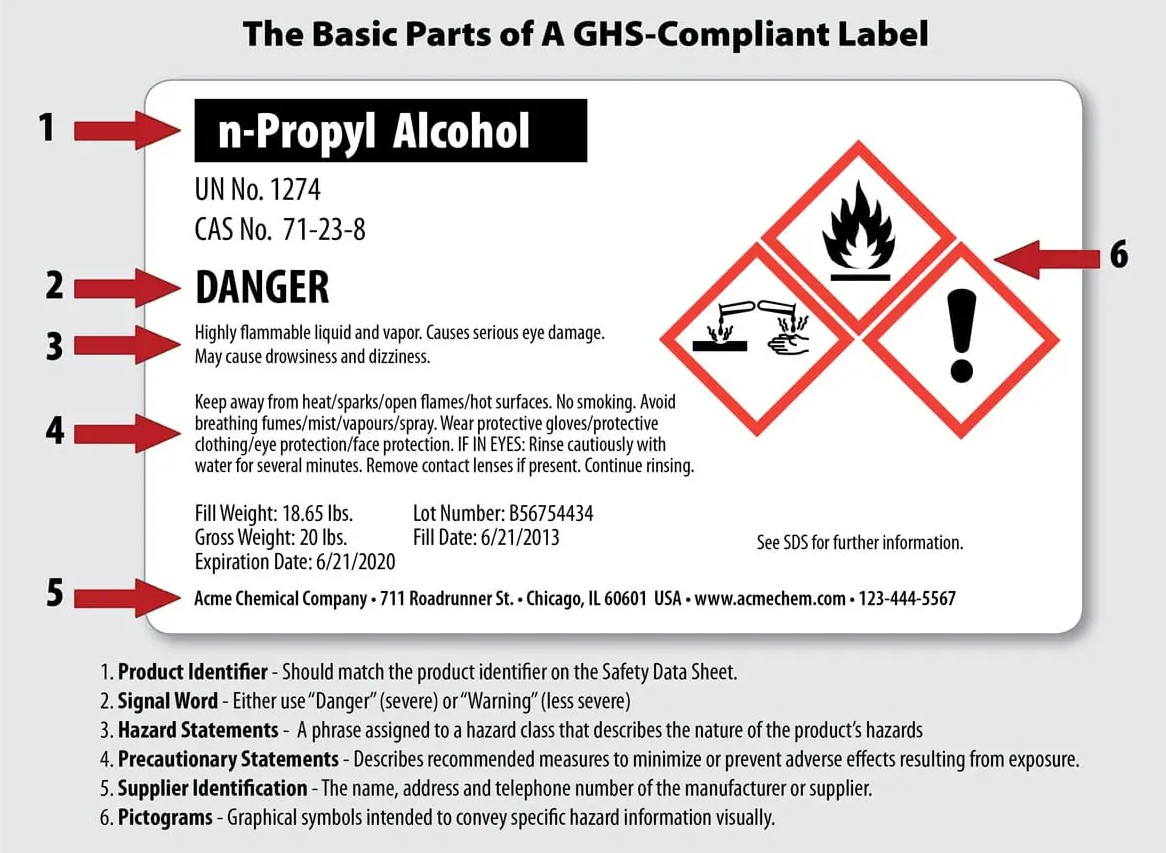
The Basic Parts of A GHS-Compliant Label
- n-Propyl Alcohol
UN No. 1274
CAS No. 71-23-8 - DANGER
- Highly flammable liquid and vapor. Causes serious eye damage.
May cause drowsiness and dizziness. - Keep away from heat/sparks/open flames/hot surfaces. No smoking. Avoid breathing fumes/mist/vapours/spray.
Wear protective gloves/protective clothing/eye protection/face protection. IF IN EYES:
Rinse cautiously with water for several minutes. Remove contact lenses if present.
Continue rinsing.
- Fill Weight: 18.65 lbs.
Lot Number: B56754434
Gross Weight: 20 lbs.
Fill Date: 6/21/2013
Expiration Date: 6/21/2020
See SDS for further information.
- Fill Weight: 18.65 lbs.
- Acme Chemical Company . 711 Roadrunner St. . Chicago, IL 60601 USA . www.acmechem.com . 123-444-5567
Description
1. Product Identifier - Should match the product identifier on the Safety Data Sheet.
2. Signal Word - Either use"Danger"(severe) or"Warning" (less severe)
3. Hazard Statements - A phrase assigned to a hazard class that describes the nature
of the product's hazards
4. Precautionary Statements - Describes recommended measures to minimize or prevent
adverse effects resulting from exposure.
5. Supplier Identification - The name, address and telephone number of the manufacturer
or supplier.
6. Pictograms - Graphical symbols intended to convey specific hazard information visually.