


Dimitris Assanis, PhD
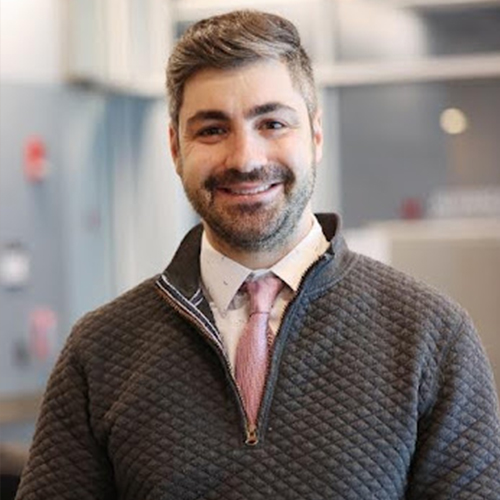 Associate Professor, Mechanical Engineering
Phone: 631-632-8022
Email: dimitris.assanis@stonybrook.edu
Office: Light Engineering 131
Lab Website: Advanced Combustion & Energy Systems (ACES) Laboratory
Education:
- University of Michigan, Mechanical Engineering, Ph.D. 2016
- University of Michigan, Mechanical Engineering, M.S. 2012
- University of Michigan, Mechanical Engineering, B.S. 2011
Professional Experience:
- Associate Professor, Mechanical Engineering, Stony Brook University, 2025 - present
- Assistant Professor, Mechanical Engineering, Stony Brook University, 2020 – 2025
Research Interests and History:
Dimitris Assanis is an Assistant Professor of Mechanical Engineering at Stony Brook University and an affiliate of the Institute for Advanced Computational Science. His research focuses on power generation and propulsion systems with an emphasis on advanced combustion modes and alternative fuels for internal combustion engines. His latest interests have led him to assess the energy and environmental implications of connected & automated vehicles.
Overview:
Dimitris Assanis leads research on clean, high‑efficiency combustion systems and the practical decarbonization of engines and distributed power—especially using hydrogen, ammonia, and bio‑derived fuels. His work combines experiments, advanced optical/diagnostic measurements, and high‑fidelity simulation/AI to reduce emissions (NOx, soot/PM, methane slip) while maintaining reliability and performance. He has led and contributed to multi‑agency research programs and collaborates with industry and national labs on next‑generation, low‑carbon energy technologies.
Accomplishments:
- Patented Passively-Fueled Dual Pre-Chamber Cylinder Head Design with Automotive OEM
- Hydrogen and Ammonia Fueled Engine Combustion Laboratory Capabilities (One of Few in U.S.!)
- Demonstrated Heavy Decarbonization of SI & CI Engines Using Carbon-Free Fuels (H2 and NH3)
- Developed a Scaled (5-50 SLPM) Engine Exhaust Sampling Testbed to Accelerate Aftertreatment R&D
Research Areas:
Research Interests:
Advanced Energy
The Advanced Combustion & Energy Systems (ACES) Laboratory develops high-efficiency, low-emission energy-conversion systems for transportation, distributed power, and the evolving electric grid. Professor Assanis’ research spans advanced engines, solid-oxide fuel-cell/engine hybrids, and fuel-flexible systems using hydrogen, ammonia, renewable fuels, natural gas, and carbon-recycling pathways. Current work advances hydrogen production, storage, and utilization; field validation of hydrogen-capable linear generators; and resilient, dispatchable power for New York. Looking ahead, the group is developing modular hydrogen-plus-renewables energy systems that integrate power generation, thermal management, emissions control, storage, controls, and grid-facing operation.
Design & Manufacturing
Professor Assanis’ research translates combustion and energy-conversion science into practical, configurable hardware platforms. The ACES Laboratory designs, integrates, and validates flexible engine and power-generation test systems, fuel-delivery architectures, emissions and aftertreatment testbeds, high-speed data-acquisition systems, and mobile field-measurement laboratories. This work combines computer-aided engineering, instrumentation, controls, safety, and design-for-testability to accelerate development of fuel-flexible and low-emission technologies. Future efforts will couple AI-enabled design tools and digital twins with prototype development, enabling rapid optimization and deployment of advanced combustion, hydrogen-power, and laser-enabled ignition systems.
Fluid Mechanics
The laboratory investigates the fluid-mechanical processes that govern fuel injection, spray breakup and evaporation, turbulent mixing, ignition, flame propagation, and pollutant formation in advanced energy systems. Professor Assanis combines optical measurements with high-fidelity CFD and large-eddy simulation to resolve complex reacting flows in engines, combustors, and novel propulsion devices. Past work has addressed gasoline spray behavior, low-temperature combustion, fuel stratification, pre-chamber combustion, and aerodynamic flow structures; current work extends these foundations to hydrogen, ammonia, methane, and multi-fuel combustion. Future research will develop predictive, data-informed models and control strategies for turbulent reacting flows across a wide range of power-generation and propulsion applications.
Optics
Professor Assanis uses optical science and imaging as essential tools for observing and controlling otherwise inaccessible combustion phenomena. The ACES Laboratory employs high-speed imaging, optical-access combustion systems, extinction-based spray diagnostics, tomographic reconstruction, and laser-based approaches to quantify fuel sprays, mixture formation, flame development, and combustion instabilities. These methods provide the experimental foundation for validating computational models and advancing clean-fuel technologies. Building on this work, the group is developing laser-enabled ignition and photochemical reactivity-control concepts for hydrogen, ammonia, and other difficult-to-ignite fuels, together with next-generation nonintrusive diagnostics for high-speed energy-conversion devices.
Thermodynamics
Professor Assanis’ thermodynamics research focuses on extracting more useful work from fuels and energy carriers while minimizing emissions and thermal losses. His group studies heat release, ignition chemistry, fuel reactivity, gas exchange, heat transfer, and efficiency limits in spark-ignition, compression-ignition, hybrid, and electrochemical-thermal energy systems. Previous work has addressed HCCI and RCCI combustion, reformate and anode-off-gas utilization, advanced biofuels, and combined heat-and-power concepts. Current and future research emphasizes hydrogen- and ammonia-fueled power systems, thermal integration of hybrid energy technologies, waste-heat recovery, and thermochemical pathways for carbon recycling and resilient decarbonized energy systems.