


Networked Quantum Sensing
In collaboration with the Instrumentation Division of the Brookhaven National Laboratory, we study applications of quantum networks and entanglement distribution for quantum
sensing, among them:
Long-base-line particle detection
Entanglement distribution in a quantum internet of quantum devices can enhance optical
interferometric observations, providing a quantum advantage in resolution. The use
of distributed matter-matter entanglement creates large line-of-sight arrays of entangled
sensors with quantum advantages in sensitivity, as well as prepares entangled matter
nodes into clock-sensitive states. A quantum network of atomic clocks can be created
to reach the Heisenberg quantum limit in precision. We are developing the quantum
network infrastructure to develop distributed atomic quantum sensors based upon atomic
quantum memories. Here, a long baseline wave function is measured simultaneously (locally)
by several light-matter interfaces (quantum memories). The quantum non-demolition
measurement of the local probability of finding the particle at the memory location
is executed through a non-local nonlinear photon-photon interaction, which modifies
the state of sensing photons that are applied constantly to the memory. Characterizing
very precisely this sensing signature it is thus paramount to estimate the extended
wave function, this is done by performing measurements across a network of quantum
memories.
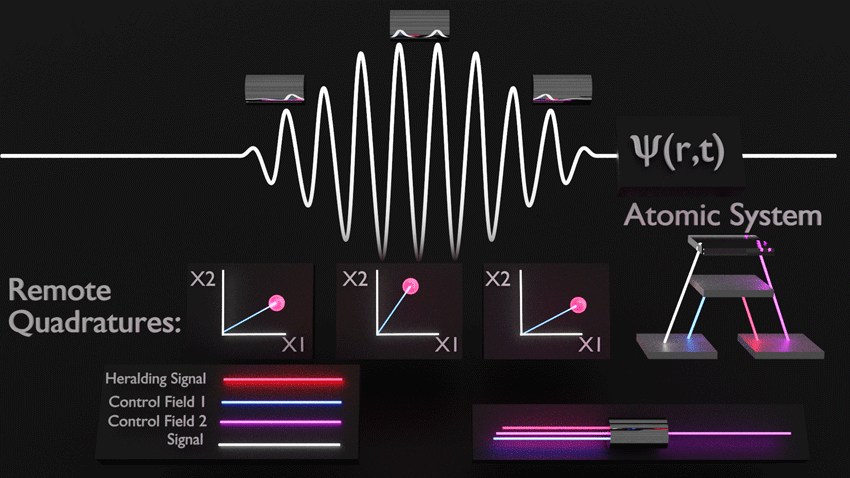
Concept of long-baseline particle detection using networked systems of heralded quantum memory systems.
Quantum Astronomy
Improving angular resolution in astronomical instrumentation has long been pursued
in order to advance many subfields of astronomy. Although traditional optical interferometry
is a well-established, successful astronomical technique, the optical path between
different detection stations, required to interfere photons, limits the achievable
baselines to hundreds of meters. We are developing a novel type of optical interferometer
that utilizes quantum mechanical two-photon interference effects and can improve astrometric
precision by orders of magnitude. The first photon will be a sky photon from a bright
star and the second photon will come from a SPDC source. The main feature of the proposed
interferometer is that it bypasses the traditional necessity of establishing a live,
phase-stabilized optical path connecting detection sites, so the baseline distance
can be made arbitrarily large. Consequently, an improvement of several orders of magnitude
in angular resolution is in principle attainable.
These ideas overlap with the Hanbury-Brown & Twiss intensity correlation technique in astrometry, which can measure stellar diameters by employing two-photon enhancement effects. There are many scientific opportunities that would benefit from substantial improvements in astrometric precision. To list just a few: testing theories of gravity by direct imaging of black hole accretion discs, measuring ultra--high-precision parallaxes to calibrate the cosmic distance ladder, mapping microlensing events, and measuring peculiar motions of stars to understand the distribution of dark matter. These ideas offer a compelling new way forward based on quantum information science: one that is much lower in cost, one that can be multiplexed to yield signal-to-noise ratios comparable or superior to amplitude-based interferometers, and finally, one that does not require light from stations to interfere at a common location (leading to longer baselines and higher image resolution).
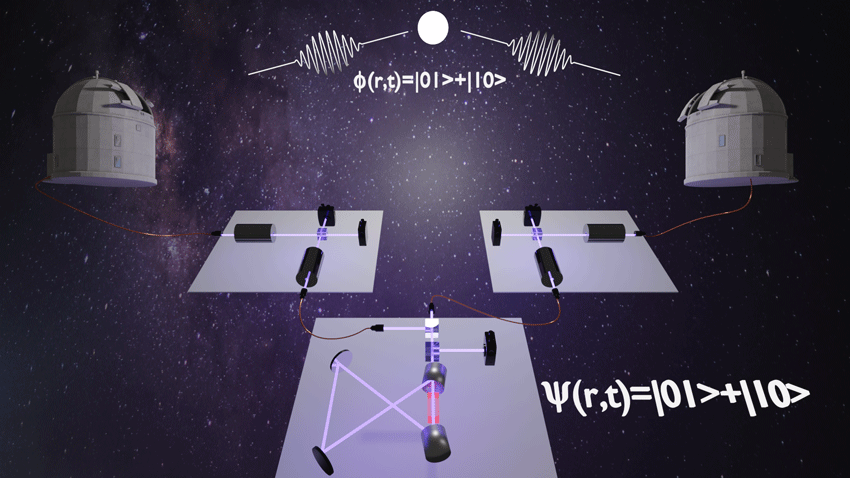
Concept of a quantum astrometry measurement using entanglement generation, distribution, quantum memory storage and interference with sky photons.