


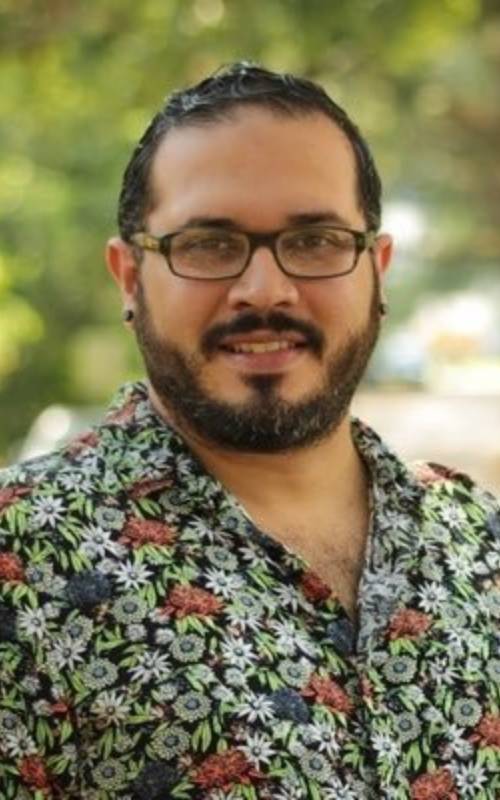
Luis Santiago-Rosario, PRODiG+ Fellow
Ecological stoichiometry, plant ecology, and plant–animal interactions
Email: luis.santiagorosario@stonybrook.edu
Office: LS677A
Research Summary:
Organisms live within complex chemical environments that shape their physiology, interactions,
and distributions. Yet these chemical landscapes are increasingly being altered by
global change, including urbanization, pollution, nutrient enrichment, and other forms
of human-driven environmental change. My research seeks to understand how variation
in the availability and distribution of elements shapes ecological interactions, and
how these relationships scale from individual organisms to communities and across
geographic regions.
At the core of my work, I integrate chemical ecology, ecological stoichiometry, global
change biology, and natural history to investigate how organisms acquire, regulate,
and respond to chemical resources. I am particularly interested in elements that are
essential but often overlooked in ecological research (such as microelements), and
in understanding how anthropogenic environments create new chemical conditions that
influence species interactions and community assembly. Urban ecosystems provide powerful
natural laboratories for examining these processes because they generate strong and
spatially heterogeneous gradients in nutrients, pollutants, and other elements.
Parasitic plants, particularly mistletoes, provide a complementary system for exploring
these questions across ecological and geographic scales. Because mistletoes acquire
water and nutrients directly from their hosts, they offer a unique opportunity to
investigate how consumers track, accumulate, or regulate resources obtained from other
organisms. By combining field studies, elemental chemistry, experiments, large biodiversity
datasets, and comparative and macroecological approaches, I investigate how host chemistry
shapes parasitic plants, how mistletoe-host interactions vary across environments,
and how climate, geography, and evolutionary history structure these interactions
globally.
Together, these approaches allow us to connect processes occurring within individual
plant-consumer interactions to broader patterns of biodiversity and global change.
Ultimately, my research goal is to develop a more mechanistic understanding of how
environmental chemistry structures ecological systems and how rapidly changing chemical
landscapes will reshape species interactions and communities in the future.